News Crypto Regulation
OECD CARF Ratification Advances After French Senate Adopts Bill 921
Key points
On 27 October 2026 the French Senate adopted Bill 921 to ratify participation in the OECD CARF multilateral agreement and enable automatic exchange of crypto-asset tax data.

The French Senate on 27 October 2026 adopted Bill No. 921 in first reading without amendments. The measure ratifies France’s participation in the OECD Crypto-Asset Reporting Framework (CARF) multilateral agreement and an addendum to the Common Reporting Standard.
The vote authorizes signature of agreements reached on 26 November 2024 in Asunción, Paraguay, alongside roughly 48 other jurisdictions. The bill does not introduce new taxes; it permits automatic exchange of data already collected under existing domestic rules.
Provisions of Bill 921 and Reporting Requirements
Under the ratified framework, crypto-asset service providers must supply user identity, tax residence and tax identification numbers. They must also report annual aggregates by asset, including transaction counts, quantities transacted and total values for crypto-to-fiat trades, crypto-to-crypto swaps and certain transfers to self-custody wallets.
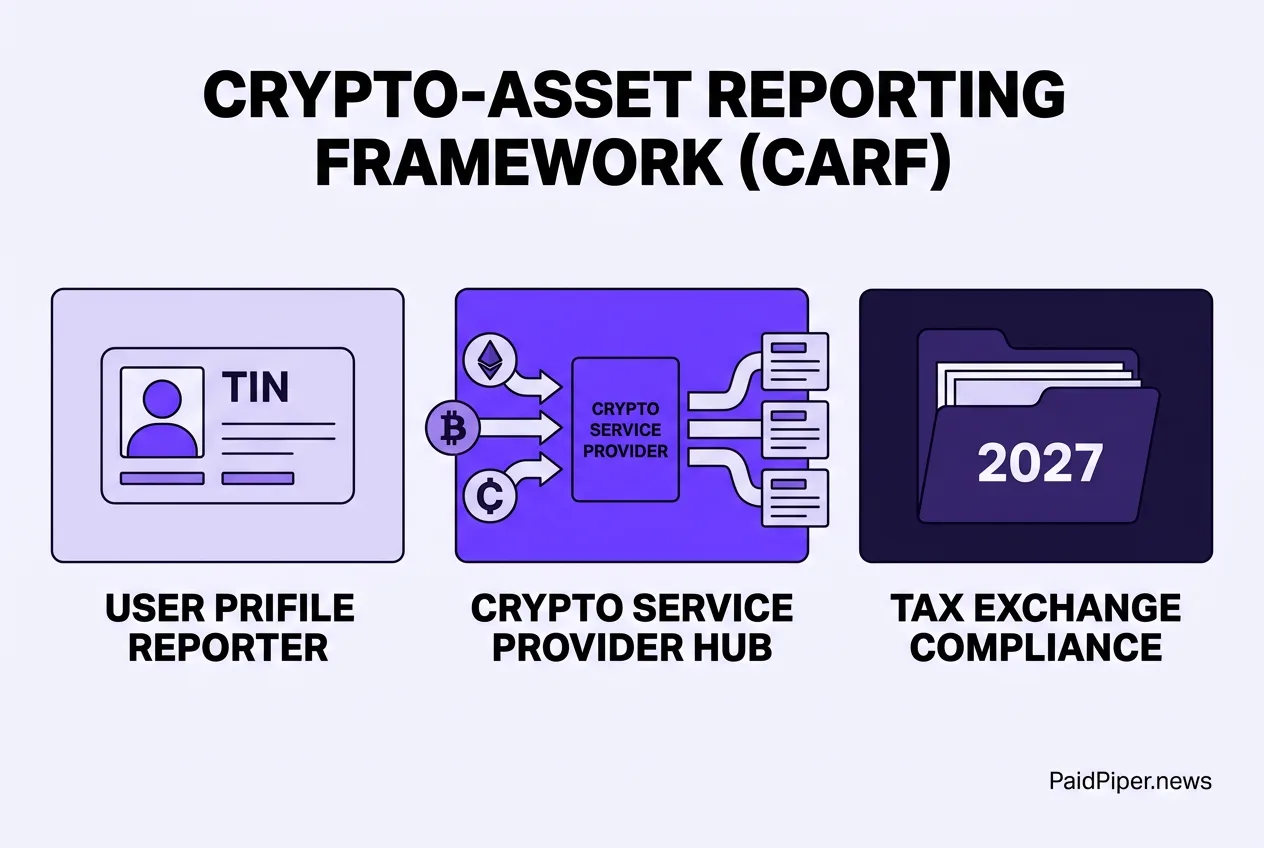
Data collection for CARF-relevant transactions began on 1 January 2026 in France and across the EU following transposition of EU DAC8 rules in the 2025 Finance Act. First exchanges of 2026 data are scheduled to begin in 2027 among an initial group of 46 jurisdictions that includes France, the United Kingdom, Japan and Germany.
The OECD developed CARF in 2022 at the request of G20 finance ministers. The standard extends automatic exchange of information principles to crypto assets in the same manner that the CRS applies to traditional financial accounts. By late 2026, 56 jurisdictions had signed the CARF multilateral competent authority agreement, with 77 jurisdictions committed overall according to OECD and Global Forum lists.
Legislative Path Forward and Market Context
The bill now proceeds to the National Assembly as Bill No. 3421. An accelerated procedure applies, though final adoption remains necessary before France can participate in the 2027 exchange round. Parallel discussions on domestic crypto tax rules continue within the 2027 budget process.
France already maintains domestic crypto reporting obligations. The CARF ratification extends these obligations to cross-border automatic exchange without altering the underlying data collection requirements. Reporting covers platforms that provide custody, exchange or transfer services for crypto assets.
Implementation timelines indicate broader rollout to all 77 committed jurisdictions by 2029. Jurisdictions scheduled for first exchanges in 2027 must transmit data covering the 2026 calendar year once domestic legislation is fully in force.
Frequently asked questions
What data must crypto platforms report under the OECD CARF?
Platforms must report user identity details, tax residence and tax ID numbers along with annual aggregates of transaction counts, quantities and values for crypto-to-fiat, crypto-to-crypto and certain self-custody transfers.
When will France begin exchanging CARF data with other jurisdictions?
First exchanges of 2026 data are scheduled to start in 2027 among the initial group of 46 jurisdictions once the National Assembly completes legislative approval.
Does the French Senate vote create new crypto taxes?
No. Bill 921 enables automatic exchange of data already collected under existing domestic rules; it does not introduce new tax obligations.
How many jurisdictions have committed to the CARF standard?
Seventy-seven jurisdictions have committed to the CARF, with 56 having signed the multilateral competent authority agreement by late 2026.
Comments
No comments yet. Be the first!