News Fedwire
Fedwire Blockchain Pilot Interbank Settlement Tests Lack Verified Results
Key points
Official records show no confirmed Fedwire blockchain pilot delivering interbank settlement test results by October 19, 2026.
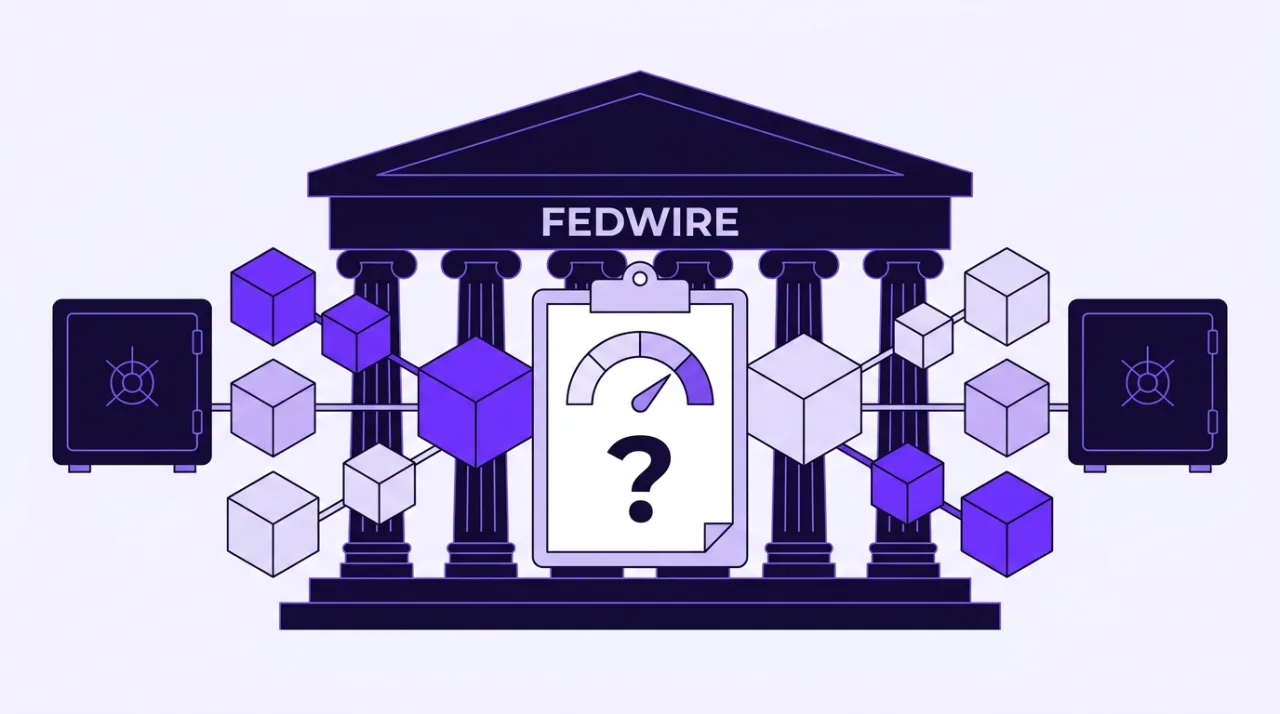
Fedwire, the Federal Reserve’s large-value payment system, has no verified blockchain pilot that has released first interbank settlement test results as of October 19, 2026. Extensive checks of Federal Reserve announcements, New York Innovation Center reports, and industry filings turned up no matching documentation for a production-grade Fedwire blockchain integration.
The system itself continues to handle the bulk of U.S. dollar wholesale payments. In 2025 it processed roughly 1.15 quadrillion dollars, averaging 4.6 trillion dollars per business day. Operations run approximately 22 hours on weekdays, with weekend expansion not scheduled before 2028.
Fed and NYIC Research Projects Provide Context on DLT Settlement
Earlier New York Fed experiments explored distributed ledger technology for atomic settlement. Project Cedar Phase I in 2022 demonstrated simulated foreign-exchange trades settling in under 15 seconds on a prototype ledger, yet the work used test data only and did not connect to live Fedwire rails. A later Regulated Liability Network proof-of-concept involving Citi and Wells Fargo examined tokenized deposits on a shared ledger, again without moving real balances through the existing Fedwire infrastructure.
Current Federal Reserve exploration continues under initiatives such as Project Pine, which studies smart-contract applications for monetary-policy operations. These efforts remain at the research stage and have not produced production settlement volumes or public interbank test statistics tied to Fedwire.
International Tokenized-Deposit Trials Offer Comparative Data
Outside the United States, several central-bank and banking consortia have published results from real-value tests. The Bank for International Settlements Project Agorá completed a July 2026 trial in which 28 banks and central banks moved roughly 800,000 Swiss francs across six currencies in 30 transactions, achieving average atomic settlement in about 80 seconds on a shared ledger using tokenized deposits.

Switzerland’s September 2025 pilot saw PostFinance, Sygnum, and UBS execute legally binding interbank payments on an Ethereum-based network of deposit tokens, with final settlement still occurring in the Swiss Interbank Clearing system. The United Kingdom’s GBTD project reported in September 2026 that Lloyds, NatWest, Barclays, and HSBC completed interbank tests of programmable tokenized deposits for mortgage and marketplace payments. Industry groups such as the Bank Policy Institute have outlined plans for tokenized deposit networks that could eventually interface with Fedwire, CHIPS, and RTP, with target timelines pointing to the first half of 2027, but no live integration data has been released.
Market participants tracking these developments note that any future linkage between tokenized instruments and Fedwire would require regulatory clarity on finality, reserves, and operational risk before volumes could scale. Until official results appear, existing public data remain limited to the simulation and cross-border trials described above.
Frequently asked questions
Has the Federal Reserve published results from a Fedwire blockchain pilot?
No official announcements or reports document a completed Fedwire blockchain pilot with interbank settlement test results as of October 19, 2026.
What volumes does Fedwire currently process?
Fedwire handled approximately 1.15 quadrillion dollars in 2025, with an average daily value of 4.6 trillion dollars on its standard weekday schedule.
How do BIS Project Agorá results compare to U.S. efforts?
The July 2026 BIS test moved real tokenized funds across borders in roughly 80 seconds; U.S. work such as Project Cedar has remained in simulated environments without live Fedwire integration.
When might tokenized deposits link to Fedwire operations?
Industry roadmaps point to possible integration testing in the first half of 2027, subject to regulatory approvals on finality and reserves.
Comments 1