News CBDC
SWIFT CBDC Interoperability Tests Show Connector Solution for Cross-Border Flows
Key points
SWIFT completed sandbox experiments with 38 institutions testing a connector that links CBDCs across DLT networks and traditional payment systems.
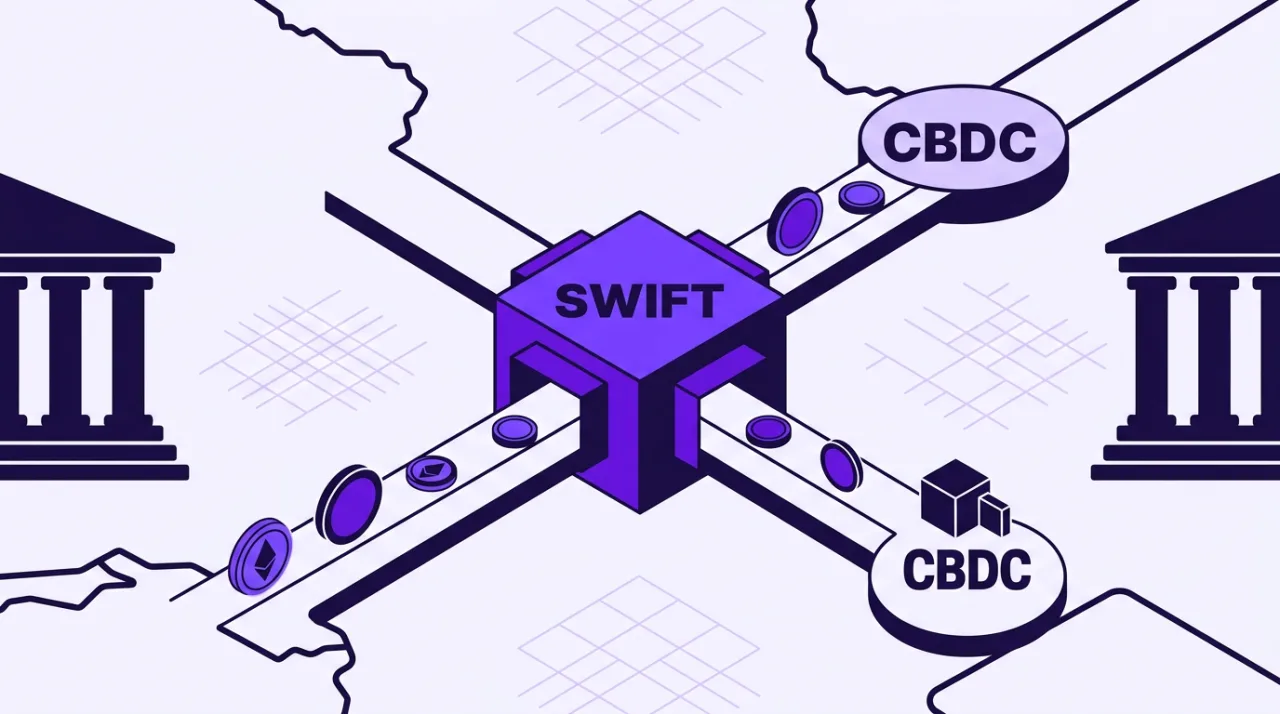
SWIFT completed multi-phase sandbox experiments that tested a connector solution for cross-border CBDC interoperability. The tests ran from 2023 through 2024 and involved central banks, commercial banks and market infrastructures across multiple distributed ledger platforms.
Phase Results and Technical Outcomes
Phase 1 concluded in March 2023 with 18 central and commercial banks simulating 4,736 transactions. Participants included Banque de France, Deutsche Bundesbank, MAS Singapore, HSBC and Standard Chartered. The tests connected Quorum and Corda networks to each other and to traditional fiat rails through a single gateway while preserving ISO 20022 messaging standards.
Phase 2 expanded to 38 institutions and ran for six months, with results released in March 2024. Central banks from Australia, Czechia, France, Germany, Singapore, Taiwan and Thailand took part alongside commercial banks such as ANZ, Citi, DBS, Deutsche Bank, HSBC and SMBC. More than 750 transactions were executed across seven simulated CBDC networks plus FX, digital trade and tokenized asset environments. The connector supported atomic delivery-versus-payment, FX netting and simultaneous payment-asset transfers.
SWIFT stated that the connector reduces fragmentation risk from separate CBDC platforms and allows institutions to reuse existing channels. Participants reported clear potential for handling complex use cases without requiring migration to a single global ledger.
Context and Ongoing Developments
Approximately 134 countries continue to explore CBDCs, with most projects focused on domestic systems. SWIFT’s connector work addresses the risk of isolated digital platforms by providing an agnostic bridge that uses existing PKI signatures and messaging formats.
Separately, SWIFT has advanced a blockchain-based shared ledger built on Hyperledger Besu for 24/7 tokenized deposits. Since August 2026, 17 banks including ANZ, Citi, HSBC, Standard Chartered and UBS have piloted live interbank transactions on this ledger, with final settlement occurring through existing rails. These pilots build on the earlier CBDC experiments but target bank-issued tokenized deposits rather than central bank liabilities.
Next steps include further beta testing, expansion to additional payment and securities use cases, and alignment with initiatives such as BIS Project Agorá. No full-scale live CBDC cross-border network using the connector has been confirmed as operational.
Frequently asked questions
What institutions participated in the SWIFT CBDC tests?
Phase 1 involved 18 central and commercial banks. Phase 2 expanded to 38 institutions including central banks from Australia, France, Germany and Singapore plus banks such as Citi, HSBC and Deutsche Bank.
How many transactions were simulated in the tests?
Phase 1 simulated 4,736 transactions. Phase 2 executed more than 750 transactions across seven CBDC networks plus FX and tokenized asset environments.
Does the SWIFT connector require a single global CBDC?
No. The connector functions as an agnostic bridge between separate DLT networks and traditional systems using ISO 20022 messaging without migration to one ledger.
What is the status of SWIFT’s tokenized deposits ledger?
A separate EVM-compatible ledger has been live-piloted since August 2026 by 17 banks for tokenized deposits with settlement through existing rails.
Comments
No comments yet. Be the first!