News Stablecoins
ASEAN stablecoin Cross-Border Project Expands with Central Bank Additions
Key points
Singapore’s MAS announced on October 23, 2026 that Bank Negara Malaysia and Bank of Thailand joined the BLOOM initiative to develop common rules for cross-border acceptance of regulated stablecoins and tokenized deposits.

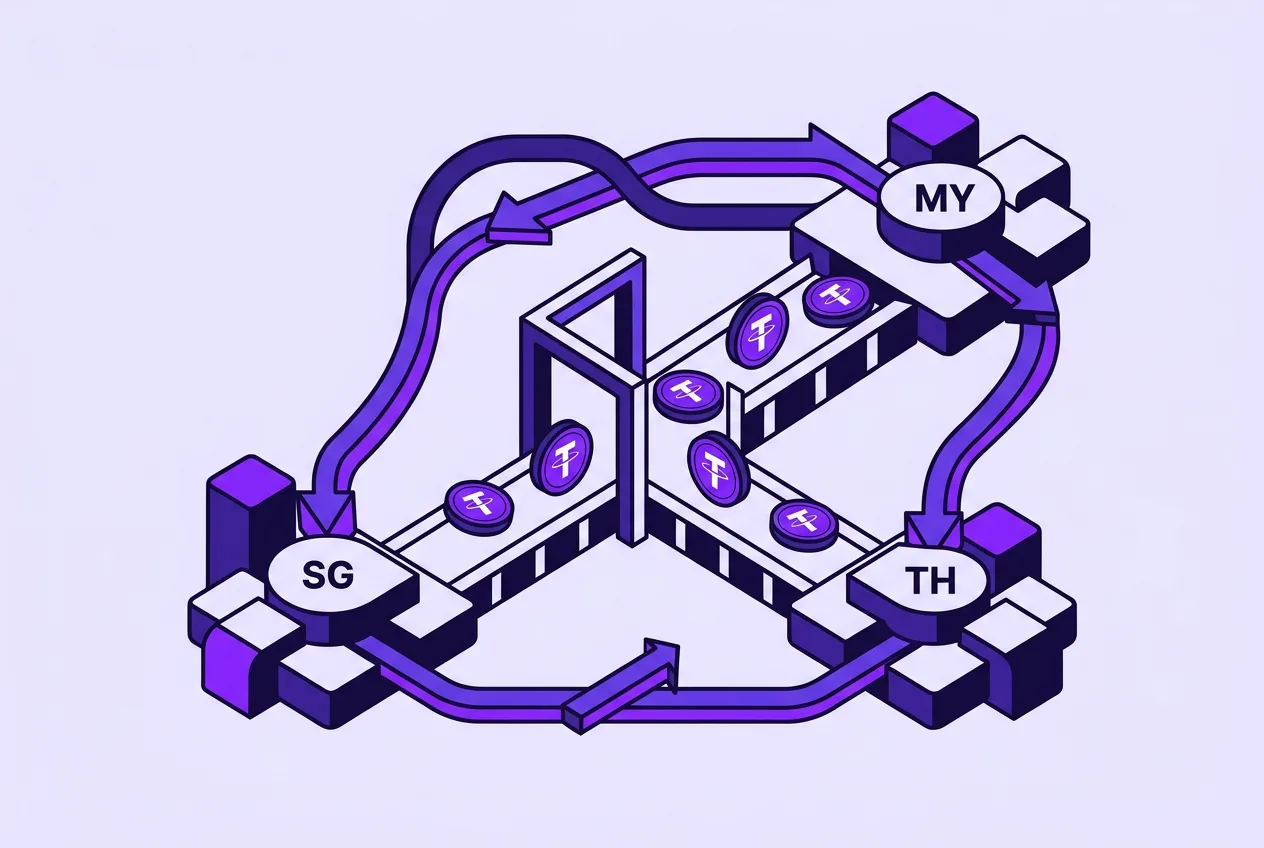
On October 23, 2026, Singapore’s Monetary Authority announced that Bank Negara Malaysia and Bank of Thailand joined the BLOOM initiative as policymaker members. The move adds the central banks of two more ASEAN economies to a public-private partnership that develops shared approaches for cross-border acceptance, exchange and settlement of tokenized bank deposits and regulated stablecoins.
Expansion of BLOOM Initiative
The announcement added new industry participants including Airwallex, Mastercard, Maybank, Monee, Nium, Ripple, ShopeePay, Visa and the World Bank Group. Existing members already include Anchorage Digital, Circle, Coinbase, DBS, J.P. Morgan, Standard Chartered, StraitsX and Stripe. The three central banks now act as policymaker members alongside these private entities.
BLOOM focuses on three core areas: acceptance and settlement across jurisdictions, interoperability between different digital money arrangements, and programmable controls such as identity verification and sanctions screening. The framework aims to reduce the need for separate bilateral agreements between every counterparty and market, which lowers operational costs and shortens time-to-market while embedding regulatory requirements from the outset.
MAS Deputy Managing Director Leong Sing Chiong stated that the collaboration supports seamless cross-border transactions involving multiple forms of digital money. BNM Deputy Governor Aznan bin Abdul Aziz described frictionless multi-digital-money payments as becoming tangible, while BOT Deputy Governor Daranee Saeju stressed the need for forward-looking yet prudent regulatory approaches for tokenized money.
Regional Context and Prior Developments
BLOOM was launched by MAS in October 2025. It builds directly on Singapore’s Project Orchid, which has explored digital Singapore dollar use cases since 2021. Malaysia began testing ringgit stablecoins and tokenized deposits in February 2026, and Thailand opened consultations on baht-backed stablecoin rules earlier in the year. The combined population of Singapore, Malaysia and Thailand reaches approximately 111 million.
Ripple joined the initiative in March 2026 to run pilots using RLUSD and the XRP Ledger for trade settlement. The new central bank participation extends these efforts beyond single-country tests toward coordinated multi-jurisdiction standards. Existing members already operate live tokenized deposit and stablecoin arrangements, providing concrete reference implementations for the interoperability work.
The initiative deliberately includes both wholesale and retail-oriented participants. Payment companies such as Visa and Mastercard sit alongside wallet providers and exchanges, reflecting the range of use cases targeted for cross-border flows. The World Bank Group’s involvement adds a development-finance perspective focused on reducing remittance costs in the region.
Technical Focus and Next Steps
Workstreams now concentrate on common settlement rails that allow a stablecoin issued in one jurisdiction to be accepted and redeemed in another without repeated bilateral legal agreements. Programmable controls are being designed to apply identity checks and sanctions screening at the protocol level rather than through post-transaction reconciliation. These standards are intended to operate across both central-bank-issued and privately-issued instruments.
No new cross-border pilot launch dates were announced in the October 23 release. The next phase centers on drafting implementation frameworks and detailed interoperability specifications. Participants will continue to test settlement mechanics on existing infrastructure while regulators refine the accompanying rule sets.
The expanded membership gives the project coverage across three of ASEAN’s largest economies and direct input from major card networks and payment firms. This structure provides a practical test bed for the technical and regulatory elements required to move tokenized deposits and stablecoins beyond domestic boundaries.
Frequently asked questions
What is the BLOOM initiative?
BLOOM is a public-private partnership launched by Singapore’s MAS in October 2025 to create common rules for cross-border acceptance, exchange and settlement of regulated stablecoins and tokenized bank deposits.
Which central banks joined BLOOM on October 23, 2026?
Bank Negara Malaysia and Bank of Thailand joined Singapore’s Monetary Authority of Singapore as policymaker members of the BLOOM initiative.
Which companies participate in BLOOM?
New participants include Ripple, Visa, Mastercard, Airwallex, Maybank, Nium and ShopeePay. Existing members include Circle, Coinbase, DBS, J.P. Morgan and Standard Chartered.
What are the main technical goals of BLOOM?
The project targets interoperability between digital money systems, common settlement procedures across borders, and programmable controls for identity verification and sanctions screening.
Comments
No comments yet. Be the first!