News Japan
Japan Stablecoin License Awarded to SBI Group Unit for First Domestic JPYSC Issuance
Key points
The Japan Financial Services Agency has confirmed SBI Shinsei Trust Bank as the first domestic trust-company issuer of a yen-pegged stablecoin under the amended Payment Services Act.

The Japan Financial Services Agency has confirmed SBI Shinsei Trust Bank as the first licensed domestic issuer of a yen-pegged stablecoin. The confirmation covers the JPYSC instrument launched on 24 June 2026 under a Type III trust model. This step follows the 2025 amendment to the Payment Services Act that took effect on 1 June 2026.
Japan Stablecoin License Requirements and SBI Compliance
SBI Shinsei Trust Bank holds the necessary trust-bank license and meets the electronic payment instrument rules introduced in June 2023. Reserves for JPYSC sit in segregated trust accounts that can include bank deposits and, since the 2026 amendment, up to 50 percent short-term Japanese government bonds. The structure provides bankruptcy remoteness and removes the one-million-yen transfer and holding caps that apply to funds-transfer models.
Issuance volume reached approximately 38 billion yen on the first day and grew to 201 billion yen by September 2026. JPYSC maintains a strict one-to-one peg with the yen. Distribution occurs initially through SBI VC Trade, the first registered electronic payment instruments exchange provider, which received its registration number 00001 on 4 March 2025. The platform also handles USDC and RLUSD.
The trust model differs from the earlier JPYC stablecoin issued by JPYC Inc. under a funds-transfer registration granted on 18 August 2025. JPYC remains subject to per-transaction limits, while JPYSC faces no such restriction because of its Type III classification.
FSA Crypto Regulation Timeline and Market Context
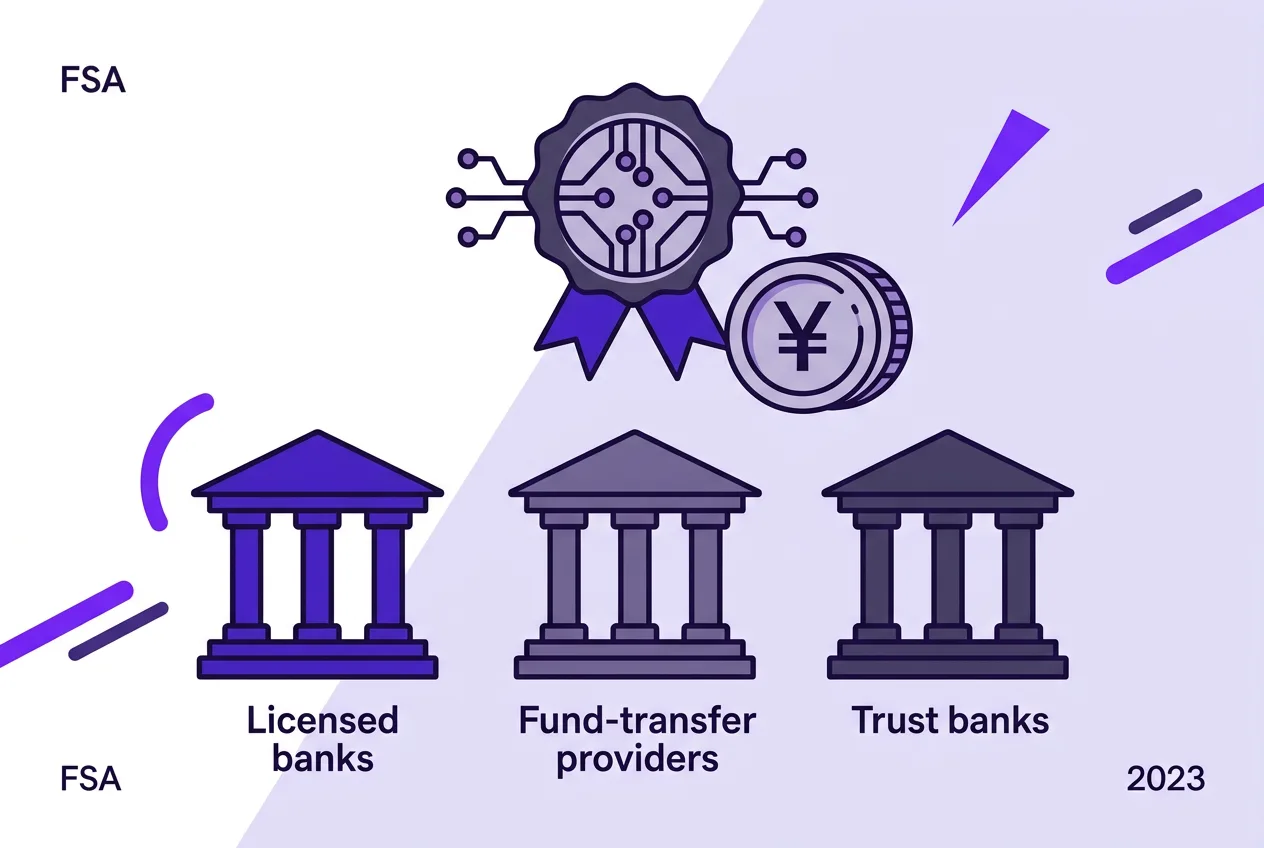
Japan’s stablecoin framework classifies yen-pegged tokens as electronic payment instruments and restricts issuance to licensed banks, fund-transfer providers, or trust companies. The June 2023 amendments and the June 2025 update clarified reserve segregation and audit obligations. FSA registers list SBI Shinsei Trust Bank as the first example of the trust-based route.
SBI VC Trade operates as one of only two registered intermediaries alongside Coincheck, which handles USDC. Public-chain circulation of JPYSC remains pending further clarification on legal and tax treatment. The issuer works with Singapore-based Startale Group on technical aspects while keeping all custody and redemption functions inside the Japanese trust structure.
Larger Japanese banks including MUFG, SMBC and Mizuho have announced joint trust-stablecoin pilots scheduled for live use in fiscal 2026. On 30 October 2026 SMBC Group acquired a 5 percent stake in an SBI Startale Marketing joint venture to explore use cases. FSA continues to review possible relaxation of holding limits and reserve composition rules in ongoing consultations.
Distribution Plans and Regulatory Next Steps
JPYSC currently circulates through account-limited channels at SBI VC Trade. Expansion to public blockchains requires additional FSA confirmation on custody and transfer rules. The issuer states the instrument targets institutional and cross-border payments once the regulatory path is complete.
Market participants watch the SBI issuance for signals on how other trust-bank applicants may proceed. Megabank pilots and potential rule adjustments could increase the number of yen-pegged instruments available to Japanese institutions by the end of 2027. All participants must maintain audited reserves and clear redemption rights under the existing framework.
Frequently asked questions
What license does SBI Shinsei Trust Bank hold for JPYSC?
SBI Shinsei Trust Bank operates under its existing trust-bank license combined with Type III specified trust beneficiary rights classification. This satisfies the electronic payment instrument rules set by the Japan Financial Services Agency.
How does the JPYSC trust model differ from JPYC?
JPYSC uses segregated trust accounts with no per-transaction caps. JPYC relies on a funds-transfer provider registration and remains subject to one-million-yen limits on transfers and holdings.
When did JPYSC issuance begin and what volumes have been recorded?
Issuance started on 24 June 2026. Day-one volume reached roughly 38 billion yen, rising to 201 billion yen by September 2026 according to SBI Group disclosures.
What is the current distribution channel for JPYSC?
JPYSC is distributed through SBI VC Trade, the first registered electronic payment instruments exchange provider. Public blockchain expansion awaits further regulatory and tax clarifications.
Comments
No comments yet. Be the first!