News ECB
ECB Pontes Links DLT Platforms to TARGET for Wholesale Tokenized Asset Settlement
Key points
The Eurosystem launched Pontes on 21 September 2026 to settle wholesale tokenized asset trades in central bank money via DLT platforms and T2.

The Eurosystem launched the Pontes platform on 21 September 2026 to connect external distributed ledger technology platforms to TARGET Services. The service allows delivery-versus-payment settlement of wholesale tokenized assets with the cash leg executed in euro central bank money through T2 or cash tokens.
Thirteen market participants completed onboarding at launch, including Deutsche Bank, Santander, Société Générale, the European Investment Bank, KfW, DZ Bank and BayernLB. Deutsche Bundesbank participated directly, and four DLT operators—Clearstream, SWIAT, Cashlink and Axiology—were ready to support transactions.
Technical Design and Settlement Process
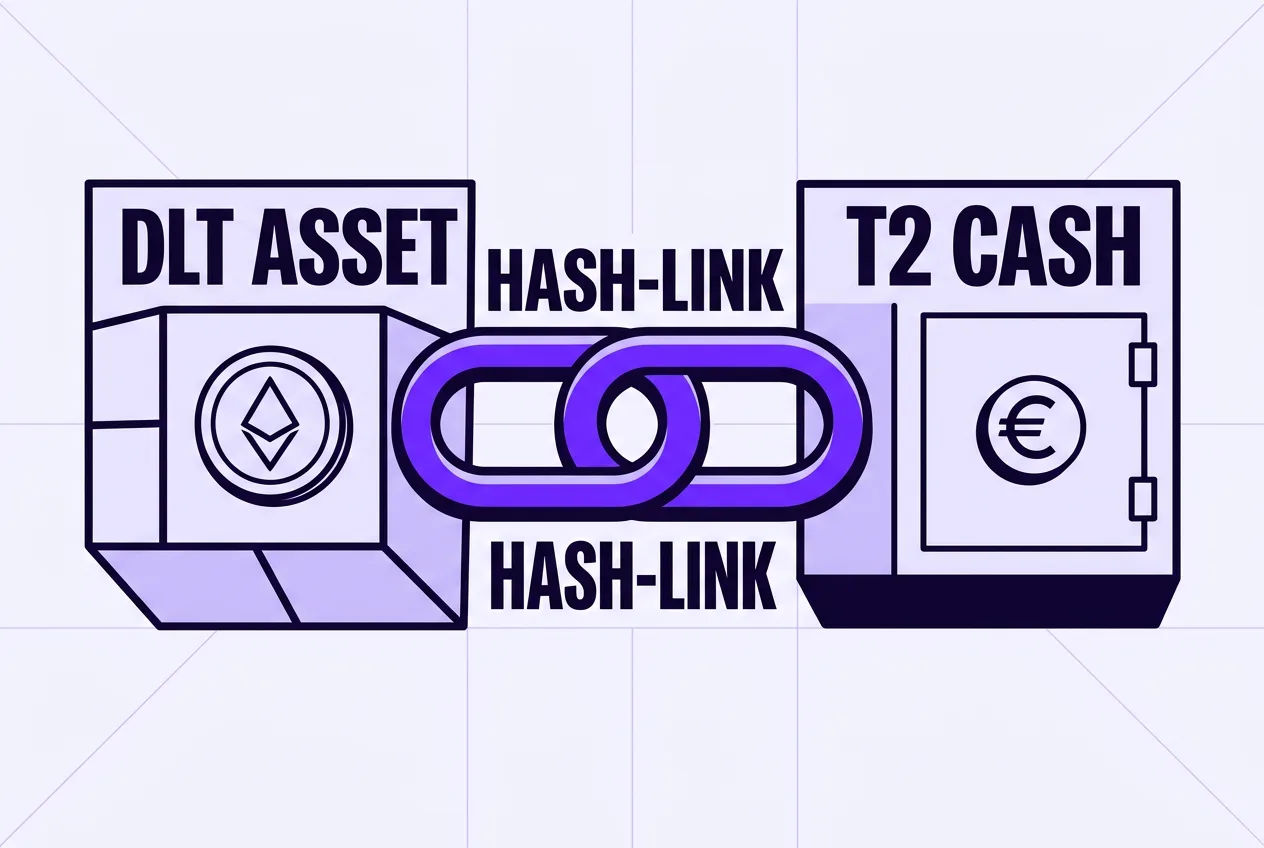
Pontes uses the Hash-Link protocol to achieve atomic settlement. The asset leg occurs on the chosen market DLT platform while the cash leg settles in central bank reserves via T2 real-time gross settlement or through cash tokens issued on the Eurosystem DLT platform. This structure delivers finality without requiring participants to move assets onto a single ledger.
Core functionality operates during TARGET business hours, roughly 08:00 to 16:00 CET. The service began with basic delivery-versus-payment capabilities; extensions for longer operating hours, greater programmability and multi-currency support are scheduled for phased release through mid-2028.
The platform forms the first operational component of the Eurosystem’s tokenized finance strategy. It follows 2024 DLT experiments that identified the requirement for risk-free settlement assets and remains separate from any retail digital euro project.
Market Participation and Next Steps
Four DLT platforms are connected at launch, one built on XRPL-derived technology. Onboarding of additional participants continues on a gradual basis. As of mid-October 2026 no public data on transaction volumes had been released.
Since March 2026, DLT-issued assets meeting eligibility criteria can already be used as collateral in Eurosystem credit operations. The ECB has also begun preparatory work to invest a limited portion of its own funds in tokenized euro-denominated public-sector debt, with settlements routed through Pontes.
Parallel work under the Appia project seeks to develop broader ecosystem standards. Market participants will be invited to contribute from 2027, with a blueprint expected in 2028. ECB President Christine Lagarde highlighted the goal of an integrated and resilient digital financial market, while Executive Board member Piero Cipollone emphasised the provision of central bank money stability to tokenized environments. Cipollone outlined Pontes role in DLT markets during recent remarks.
Frequently asked questions
What is ECB Pontes used for?
Pontes enables atomic delivery-versus-payment settlement of wholesale tokenized assets where the cash leg settles in central bank money through TARGET Services or cash tokens.
Which institutions joined Pontes at launch?
Thirteen market participants including Deutsche Bank, Santander and the European Investment Bank, plus Deutsche Bundesbank and four DLT operators, completed onboarding on 21 September 2026.
Does Pontes replace the digital euro project?
No. Pontes is a wholesale settlement service for tokenized assets and is separate from any retail central bank digital currency initiative.
When will Pontes operate 24/7?
Extended hours and additional features such as multi-currency support are planned for gradual rollout, with full implementation targeted for mid-2028.
Comments
No comments yet. Be the first!